General Properties
In RISC-V, we need 32 bits to represent the address of memory.
The data width within the memory is of 1 Byte
The total memory is the number of addresses x the width of the data:
Definition
We say that memory is byte-addressable ⇒ one address = one byte
| Name | Size | Bytes |
|---|---|---|
| Byte | bits | |
| Halfword | bits | |
| Word | bits | |
| Quadword | bits | |
| We can represent memory visually by either drawing the higher indexes at the top, or the higher index at the bottom. Both ways are interchangeable without consequences. |
One instruction occupies one word
This means that the program counter will increase by after each step
Byte Ordering
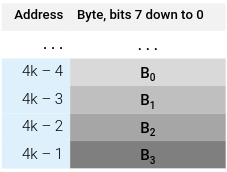
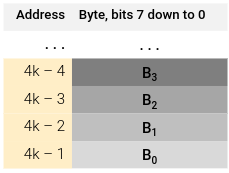
How do we represent words in memory? Should the first byte be represented as the lowest part in memory (little endian), or the highest part (big endian)?
Little Endian
The least significant bit is stored at index
Big Endian
The most significant bits of the word are stored at the lower memory address
Instruction Encoding
Example
Encoding the instruction
00 73 52 B3
- Little Endian:
We get the lowest byte (
B3) and put it at the lowest index of memory, and go up with each word:Addr: 0x00 | 0x01 | 0x02 | 0x03 | ... Mem : 0xB3 | 0x52 | 0x73 | 0x00 | ...
- Big Endian:
We get the biggest byte (
00) and put it at the lowest index of memory, and go up with each word:Addr: 0x00 | 0x01 | 0x02 | 0x03 | ... Mem : 0x00 | 0x73 | 0x52 | 0xB3 | ...
Load and Store
Memory read/write operations are called load/store
We have — in RISC-V — the instructions for loading signed and unsigned
- bytes:
lb, lbu - words:
lw
| imm | rs1 | funct3 | rd | opcode |
|---|---|---|---|---|
| 12 | 5 | 3 | 5 | 7 |
| offset | base register index | 3 bit function code | destination index | 7bit operation code OP |
Similarly, we can store:
- bytes:
sb - words:
sw
| imm | rs2 | rs1 | funct3 | rd | opcode |
|---|---|---|---|---|---|
| 7 | 5 | 5 | 3 | 5 | 7 |
| offset | base register index | register recieving value | 3 bit function code | destination index | 7bit operation code OP |