Decoder
A decoder is a logic circuit that receives bits and produces bits, where only one bit is set to one
That bit is “hot”
We have the truth table given by
We can also have an enable signal (which means that the vector when enable is )
Larger decoder can be constructed from smaller decoders
Memory
Memory allows to store bits. There are a lot of different implementations of memory.
We can represent memory as a two dimensional array. Where
- One memory element is at a row , and is called a data word (vector of bits)7
We call that index the address.
We typically store data in bytes () (8-bit vectors) ⇒ Capacity is the amount of bytes it can store
We have units:
| Unit | Bytes |
|---|---|
| Kilobyte | |
| Megabyte | |
| Gigabyte | |
| Terabyte |
Access protocols
We have multiple protocols for accessing memory.
We will consider a simple protocol:
- Synchronous write (on clock posedge)
- Asynchronous read
Array of 4x4 DFFs
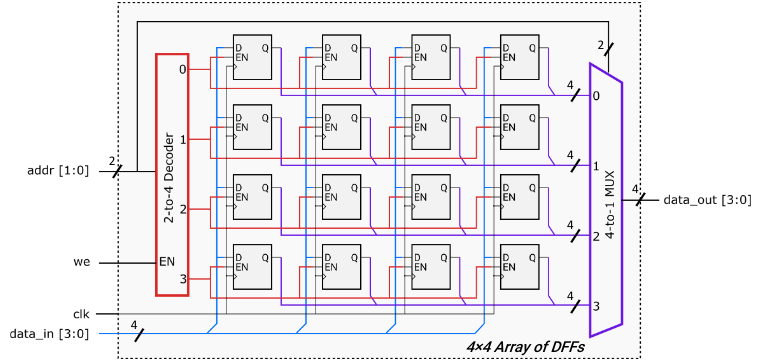
In Verilog
⇒ 1D Array of Registers;
We can declare an array of words of bits as:
reg [b-1:0] memory [w-1:0];To allow for modules where we can modify the width of vectors dynamically, we can use the parameter keyword:
// Set the default parameter of WIDTH to 1
parameter WIDTH = 1;

// Which allows use to instantiate the module with different widths
modulename #(.WIDTH(8)) instancename (/* ... */);